Gaussian 16w < PLUS ✪ >
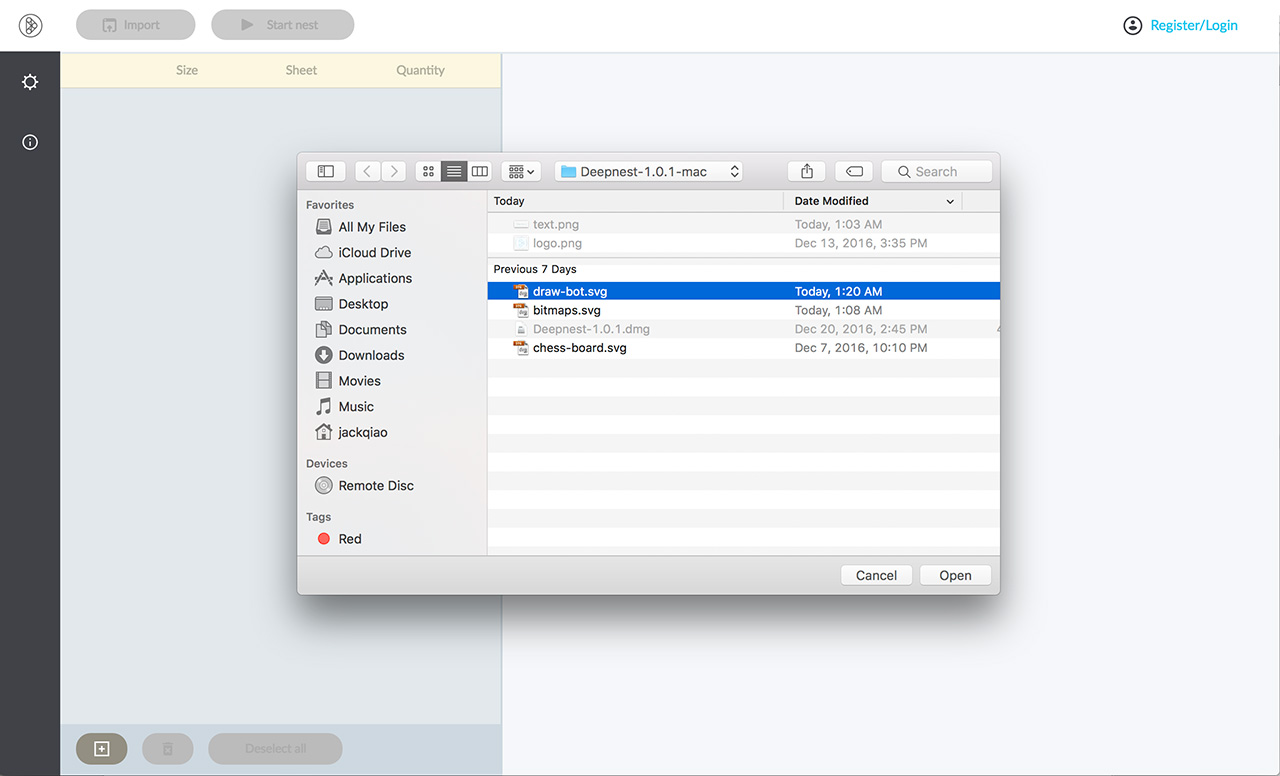
1. Import your file

2. Mark the largest part as your sheet, then hit start
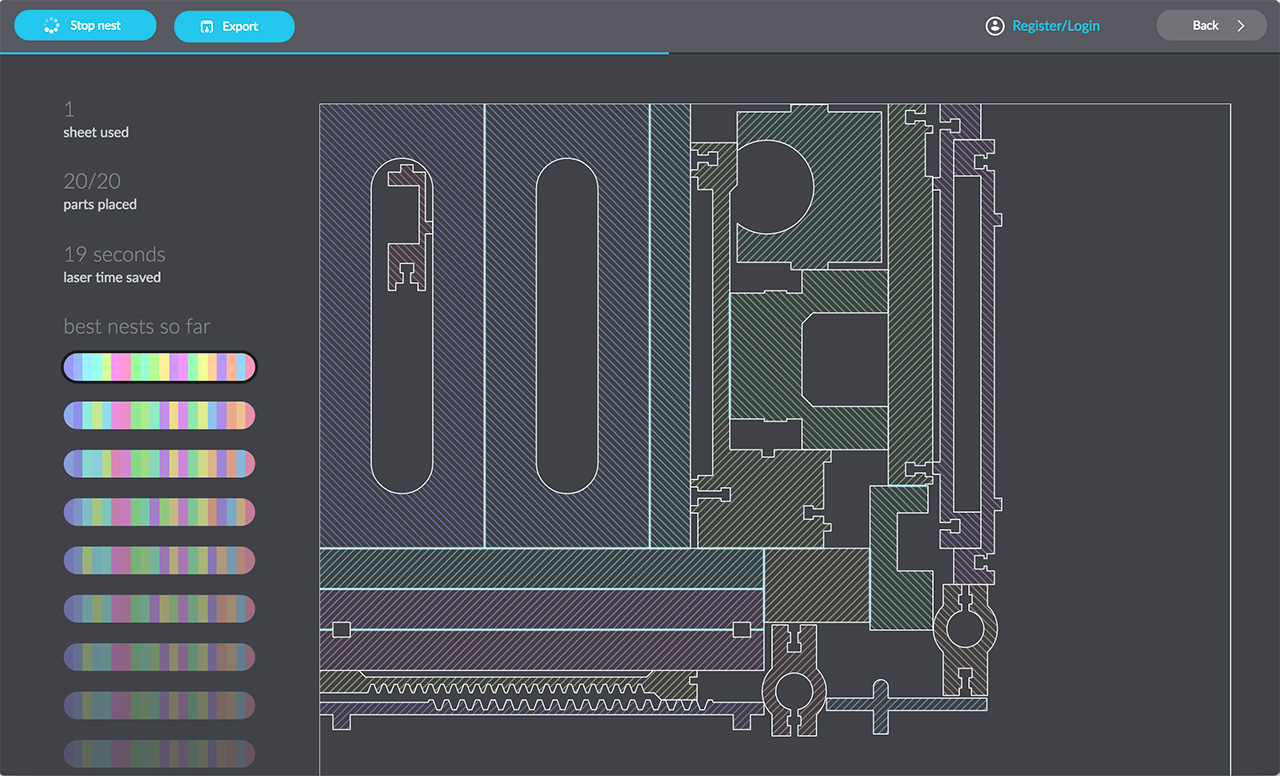
3. Deepnest will continue to search for better solutions until you hit stop
Deepnest is an open source nesting application, great for laser cutters, plasma cutters, and other CNC machines.
Gaussian 16W is the comprehensive Microsoft Windows implementation of the Gaussian 16 program package, the industry-standard software suite for computational chemistry. It enables researchers, chemists, and physicists to model complex molecular systems and predict their electronic structures, energies, and spectroscopic properties based on the fundamental laws of quantum mechanics. Core Capabilities and Features Gaussian 16W provides state-of-the-art tools for electronic structure modeling, supporting a vast array of theoretical methods and molecular property predictions. Electronic Structure Methods : Includes Hartree-Fock (HF), Density Functional Theory (DFT), Møller–Plesset perturbation theory (MP2), and high-accuracy methods like Complete Basis Set (CBS) and Gaussian-n theories (G3, G4). Geometry Optimization : Efficiently locates equilibrium structures and transition states using redundant internal coordinates. Spectroscopy Prediction : Accurately predicts IR, Raman, UV/Visible, and NMR spectra. It also features advanced vibronic analysis for excited states. Excited States : Supports Time-Dependent DFT (TD-DFT), CASSCF, and SAC-CI for modeling photochemical reactions and fluorescence. Environment Modeling : Calculations can be performed for molecules in the gas phase, in solution (using solvation models like PCM), or in the solid state via Periodic Boundary Conditions (PBC). System Requirements and Editions Gaussian 16
Gaussian 16W is the Windows-based version of the Gaussian 16 electronic structure modeling software. It provides a full implementation of the Gaussian 16 suite, featuring a specialized graphical user interface for managing chemical modeling jobs on Windows PCs. Gaussian.com Core Modeling & Scientific Features Gaussian 16W includes all the modeling capabilities of the standard Gaussian 16 package: Hearne Software Energy Calculations : Supports a wide range of methods including Hartree-Fock Density Functional Theory (DFT) , MP2, and Coupled Cluster. Geometry Optimization : Efficiently locates equilibrium structures and transition states using redundant internal coordinates Vibrational Analysis : Predicts IR and Raman spectra, including anharmonic vibrational analysis. Molecular Properties : Computes NMR chemical shifts, spin-spin coupling constants, and magnetic properties like G tensors. Excited States : Models electronic transitions using Time-Dependent DFT (TD-DFT) , SAC-CI, and CASSCF. Environmental Effects : Includes the Polarized Continuum Model (PCM) for modeling molecules in solution. Gaussian.com Windows-Specific Interface Features The "W" version is distinguished by its Windows-specific interactive tools: Gaussian.com Job Processing Window : A main dashboard to monitor, pause, or terminate active modeling jobs. Job Edit Window : An integrated environment for creating and modifying Gaussian input files Batch Processing : A utility to set up and sequentially execute multiple jobs via Batch Control Files (.BCF) Drag-and-Drop Execution : Allows users to initiate calculations by dragging input files directly into the processing window. Utility Menu : Provides built-in access to tools like (converting checkpoint files for visualization) and (generating electron density cubes). Gaussian.com Performance & System Features Parallel Processing : Can be configured via the Default.Rou file to run on multiple processors or specify memory limits (e.g., using for CPUs and for memory). 64-bit Architecture : Optimized for modern 64-bit Windows environments, with single-computer and site-wide licensing options. GaussView Integration : Designed to work seamlessly with GaussView 6 for graphical molecule building and result visualization. Gaussian.com Gaussian 16W Reference
This is a structured technical overview and paper-style report on Gaussian 16W , the Windows version of the Gaussian 16 quantum chemistry software package.
Title: Gaussian 16W: A Comprehensive Analysis of Computational Chemistry Workflows on the Windows Platform Author: [Generated for technical review] Date: April 2026 Version: Gaussian 16 Revision C.01 (Windows) gaussian 16w
1. Abstract Gaussian 16W represents the Microsoft Windows implementation of the Gaussian 16 suite, a preeminent software package for electronic structure modeling. While Gaussian is historically associated with UNIX/Linux high-performance computing (HPC) clusters, the W-subversion offers a workstation-class environment for molecular orbital theory, density functional theory (DFT), and semi-empirical methods. This paper evaluates the architecture, performance characteristics, scope of chemical properties accessible, and practical workflow limitations of Gaussian 16W relative to its Linux counterpart. Key findings indicate that while GUI integration and ease of use are superior in 16W, scalability for large systems (e.g., >200 atoms, >1000 basis functions) is constrained by Windows memory management and lack of native parallel efficiency above 8–16 cores.
2. Introduction 2.1 Background Gaussian Inc. has maintained a Windows version since the Gaussian 98W release. Gaussian 16W continues this tradition, targeting researchers in academic or industrial settings where dedicated Linux clusters are unavailable or where local visualization and job preparation are preferred. 2.2 Objectives of this Paper
Compare the feature parity between Gaussian 16 (Linux) and 16W (Windows). Analyze computational performance on standard benchmark systems. Discuss the integration of GaussView 6W as a molecular builder and job launcher. Identify best-use cases and inherent limitations. It also features advanced vibronic analysis for excited
3. Software Architecture and Installation 3.1 System Requirements (Recommended) | Component | Specification | |-----------|----------------| | OS | Windows 10/11 Pro or Server 2019+ | | CPU | Intel Xeon or AMD Ryzen (8+ cores) | | RAM | 64 GB minimum; 256 GB recommended | | Storage | 500 GB NVMe SSD (scratch space) | | GPU | Not used for computation; only for OpenGL graphics | 3.2 Memory Model Unlike Linux where %mem controls memory allocation per core, Gaussian 16W uses a shared-memory model limited by the Windows process address space (theoretically 128 TB for 64-bit, but practically limited by system commit charge and paging file size). Crucially , the Windows version does not support distributed memory parallelism (MPI); only shared-memory parallel (SMP) via OpenMP. 3.3 Installation Components
Gaussian 16W core binaries ( g16w.exe ) Utility programs (formchk, cubegen, freqchk, etc.) GaussView 6W (optional but strongly recommended) Default basis set library and pseudo-potential database
4. Feature Comparison: Windows vs. Linux | Feature | Gaussian 16 (Linux) | Gaussian 16W | |---------|---------------------|---------------| | Maximum threads | Unlimited (scales to 128+) | Practically ≤ 32 | | MPI parallelism | Yes (distributed memory) | No | | GPU acceleration (CUDA) | Yes (limited methods) | No | | Large scratch files | Any filesystem (ext4, XFS, etc.) | NTFS (subject to 256 TB file size limit, rarely an issue) | | Link0 commands | Full support | Full support | | Route section syntax | Identical | Identical | | External scripts (shell) | Bash, Python | Batch, PowerShell (limited) | | Real-time job monitoring | tail -f | GaussView job monitor | Conclusion: Feature parity is high for serial and modest parallel runs, but Gaussian 16W lacks advanced HPC capabilities. 128 GB DDR5-5600
5. Performance Benchmarks 5.1 Test System
Hardware: Intel Core i9-13900K (24 cores, 32 threads), 128 GB DDR5-5600, NVMe SSD. Software: Windows 11 Pro 22H2, Gaussian 16W Rev C.01.
1. Import your file
2. Mark the largest part as your sheet, then hit start
3. Deepnest will continue to search for better solutions until you hit stop